
Checking Alameda County Criminal History
Start with the Alameda County record's purpose. The Alameda County Superior Court Criminal Case Portal routes public users to Odyssey for filed criminal cases and to a separate request service for copies. The Alameda County Sheriff's Inmate Locator answers a narrower question about current custody or recent booking visibility. A police report remains with the agency that created it. California DOJ supplies a fingerprint-based state summary only to the person named in the record or to an authorized agency.
Gather a full name, birth date, known spelling forms, an agency report number, or a court docket number before searching. Those details help distinguish people with similar names and let a clerk trace the right event. Work through the channels in order:
- Search Odyssey for filed Alameda County criminal court cases and hearings.
- Check the Alameda County Inmate Locator for current custody or booking data.
- Ask the arresting police agency for its incident or arrest report.
- Use the Criminal Record Request portal when a non-confidential case document is needed.
- Request a California DOJ fingerprint review when checking your own statewide summary.
Alameda County Criminal Court Portal Choices
Alameda County's court tools have distinct jobs. Odyssey requires public registration and offers Smart Search plus Search Hearings. Find Your Court Date displays calendars for up to five days, with the portal stating that its data is current as of 5:00 p.m. Pacific. The Sheriff's Criminal Docket Finder can locate a future public proceeding by docket and court or by police report and agency. It omits juvenile data and is not a full criminal history search.
The court's portal layout can prevent a common mistake: eCourt covers civil, family, probate, mental health, and adoption matters, not the criminal docket. For non-confidential copies, use the Criminal Record Request service or contact the criminal division where the case was heard.
The official criminal portal landing page shows the route into these court services.
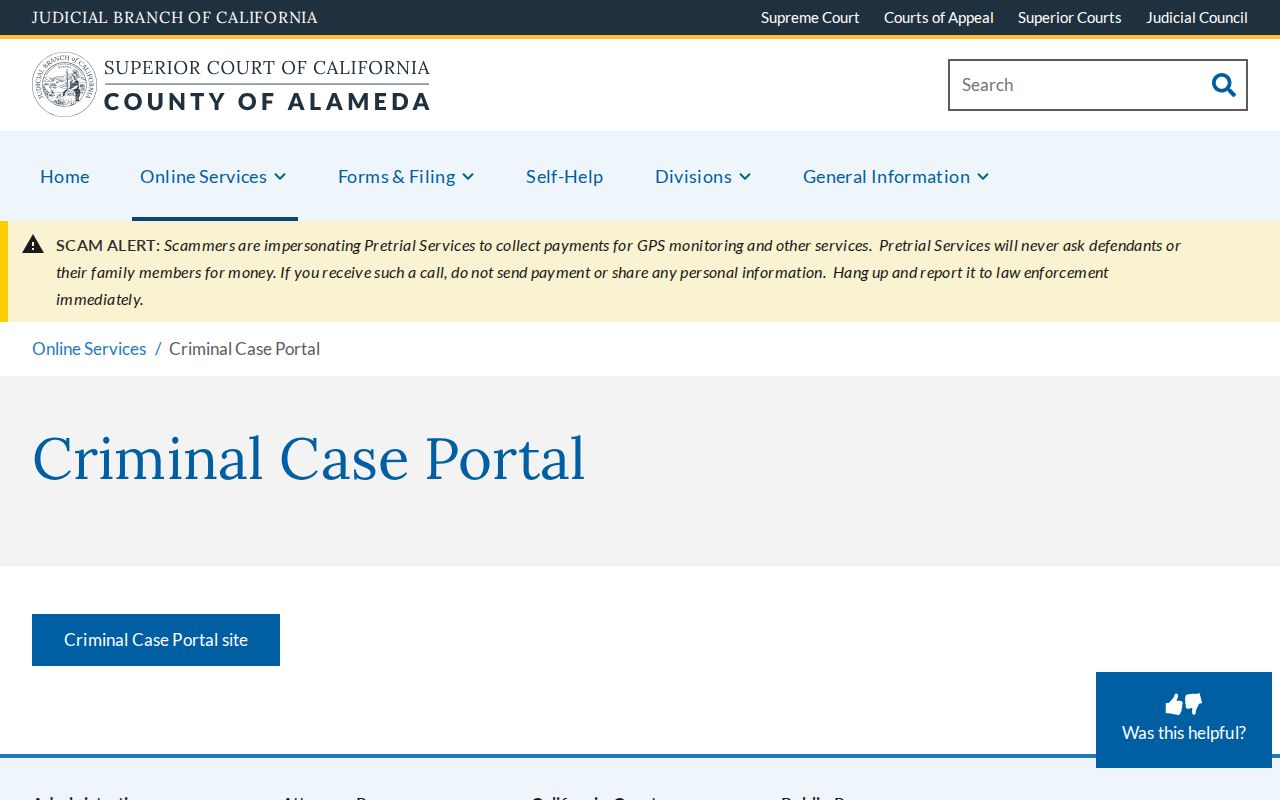
That separation matters because a calendar notice, a register of actions, and a requested case document answer different questions about the same Alameda County proceeding.
California Official Background Checks
The California Department of Justice does not provide the public with a general name-based criminal history search. Its official public-facing route is Record Review for the subject's own state summary. A California resident completes Form BCIA 8016RR, marks “Record Review” as the application type and reason, and submits fingerprints at a public Live Scan site. DOJ charges a $25 processing fee, while the site's rolling fee varies.
Out-of-state residents use Form BCIA 8705 and FD-258 fingerprint cards, then mail the packet to the Bureau of Criminal Identification and Analysis, Record Review & Challenge Section. If a response is incomplete or wrong, Form BCIA 8706 starts a challenge. The FBI Identity History Summary offers a separate federal self-review for $18.
| Official channel | Scope | Fee found |
|---|---|---|
| California DOJ Record Review | Subject's own California summary | $25 plus rolling fee |
| DOJ record challenge | Correction after review | No separate fee found |
| FBI Identity History Summary | Subject's own federal summary | $18 |
Alameda County DOJ Record Review
Fingerprint review can expose an Alameda County arrest cycle whose disposition never reached the state repository. Compare the DOJ response with the Superior Court file. If the court shows a dismissal, acquittal, or sentence that the state summary omits, obtain the supporting court record and follow DOJ's BCIA 8706 challenge instructions.
The California DOJ Record Review instructions show the current forms and Live Scan process.
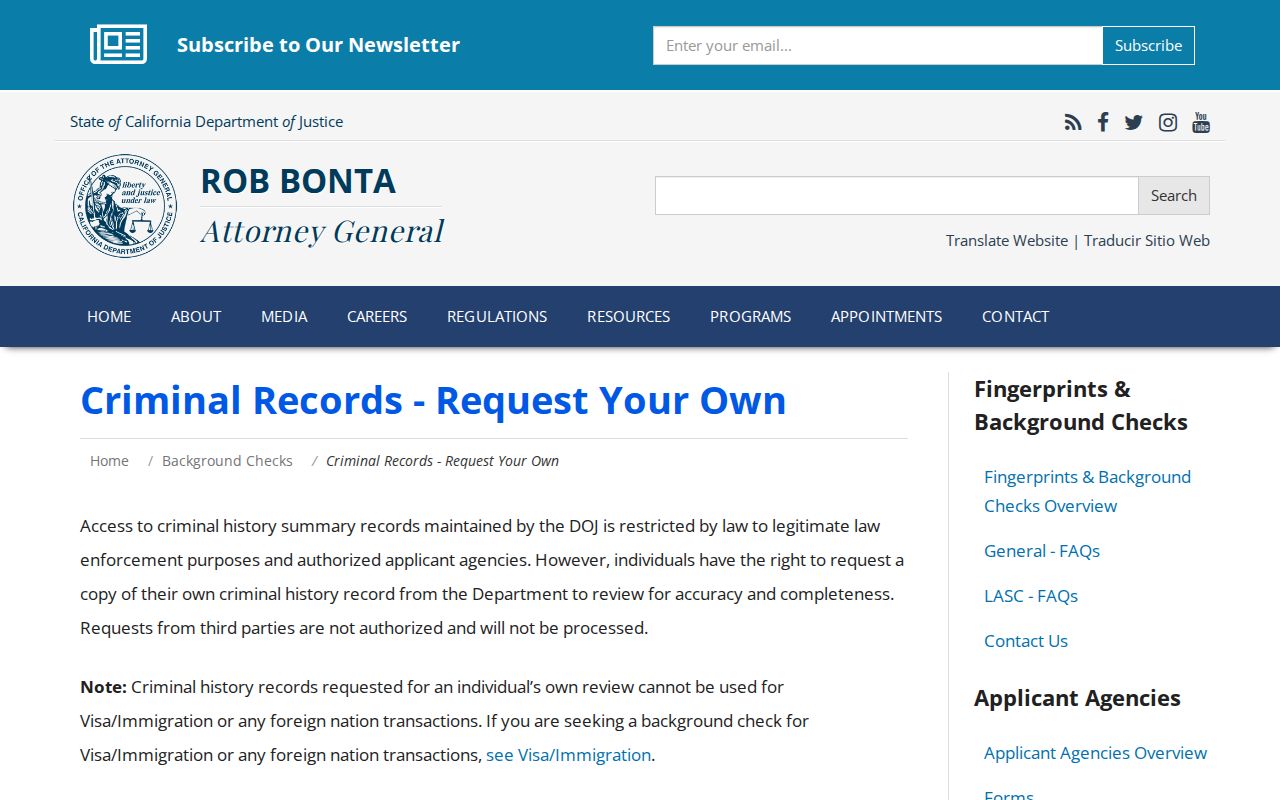
The official fingerprint route links the record to the subject more reliably than a name search and gives the subject a defined way to contest errors.
DOJ's fingerprint FAQ also explains why state summary criminal histories are confidential.
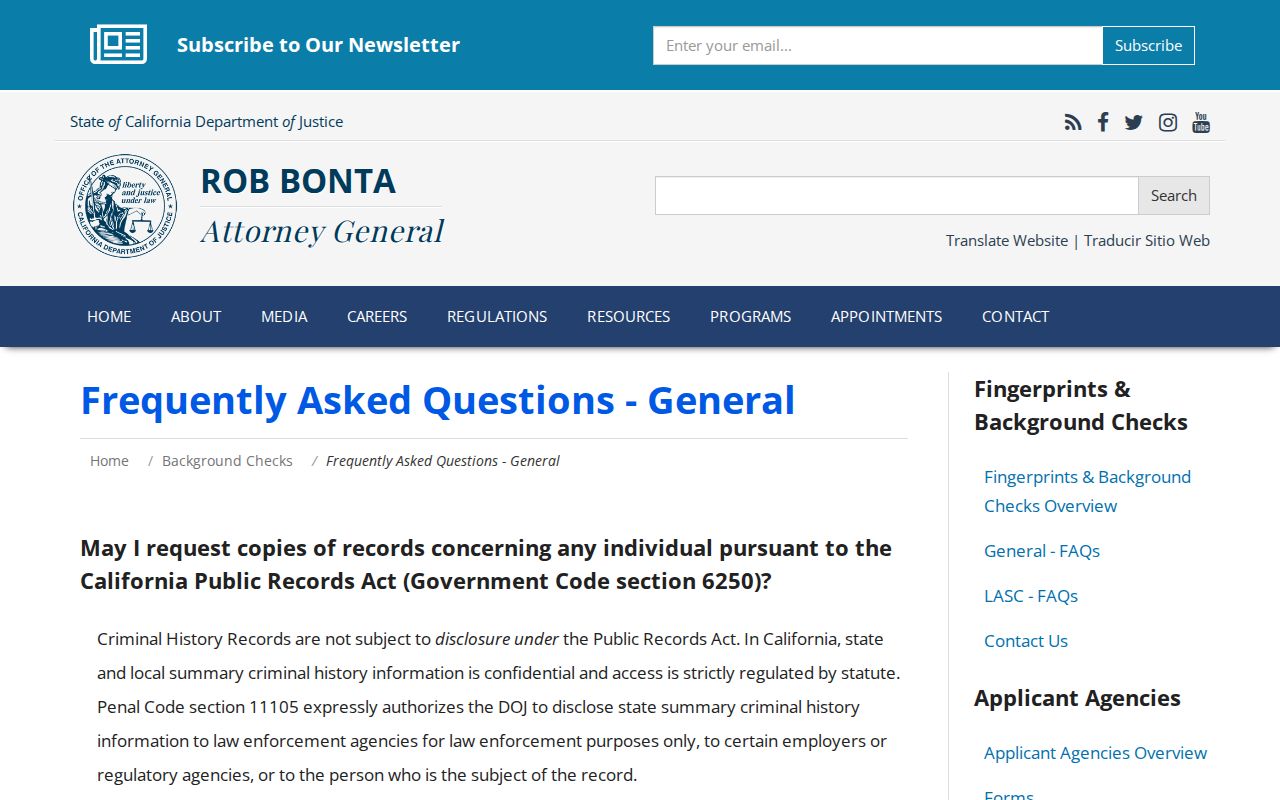
For Alameda County readers, that limit is the reason court, custody, police, and personal state-review searches cannot be treated as interchangeable.
Criminal Record Types
An Alameda County criminal event can produce several records under different custodians. The arresting agency writes an incident or arrest report. If a person is booked, the Alameda County Sheriff's Office creates custody data and a Person File Number. The Alameda County District Attorney decides whether to file charges. Alameda County Superior Court then records pleas, hearings, orders, disposition, and sentence. Fingerprint-supported Alameda County information may later reach California DOJ.
The timing also changes what a search can find. A Fremont, Hayward, or Oakland police report can exist before any Alameda County case number is assigned. A Santa Rita Jail entry can change after release, while the later court register remains. When a disposition should appear in a state summary but does not, the subject can compare the Alameda County Superior Court result with the California DOJ response and use the official challenge route.
- Police reports: held by ACSO, Oakland, Fremont, Hayward, or another reporting agency.
- Booking records: held by the jail or local detention facility.
- Court case files: held by Alameda County Superior Court after charges are filed.
- Warrant information: split among courts, police agencies, and selected ACSO notices.
- Supervision records: divided between county probation and state parole systems.
Santa Rita Jail PFN Search
The Alameda County Inmate Locator is the main official search for a person held in county custody. It accepts a PFN by itself or both first and last name. Middle name, sex, date of birth, and a phonetic option can narrow the search. A CAPTCHA is required. Santa Rita Jail at 5325 Broder Boulevard in Dublin handles custody questions at (925) 551-6500.
| Search field | Use |
|---|---|
| PFN | May be used alone |
| First and last name | Both required when PFN is not used |
| Middle name, sex, DOB | Optional matching details |
| Phonetic search | Helps when spelling is uncertain |
| Human verification | Required before submission |
Note: A missing result does not prove no arrest occurred, because the locator warns that legal exemptions may keep some booked names from display.
Inside an Alameda County Criminal Record
The fields depend on the source. A booking entry reflects the arresting agency's information at intake, while a court file tracks what prosecutors filed and what the judge decided. Charges can change. Read the disposition, meaning the case outcome, before drawing a conclusion from an arrest label or initial count.
| Name & identifiers | Legal name, aliases, birth details, and identifiers allowed in that system. |
|---|---|
| Arrest or booking | Date, agency, report number, PFN, booking charges, and custody status. |
| Charges & statutes | Filed counts, California code sections, and felony, misdemeanor, infraction, or wobbler status. |
| Disposition | Dismissal, plea, acquittal, conviction, or another final result. |
| Sentence | Custody, probation, fines, or other court orders when public. |
| Supervision | County probation, state prison, parole, or release information in the proper official system. |
Alameda County Police Reports Stay Local
There is no consolidated county police-report file. Oakland Police accepts requests through NextRequest, email, phone, mail, and its public counter. Fremont uses a release form by fax or front-desk delivery and lists a $16 report fee. Hayward takes report requests by mail or in person and uses GovQA for broader public-record requests. ACSO handles sheriff-created incidents and contract or unincorporated-area records.
Identify the agency from the incident location or report number. If charges were filed, move from the agency report to the court file for the official charging and disposition trail. Oakland's Daily Log, Fremont's Week in Review, and Hayward's police blotter or crime dashboard can offer recent public context, but none replaces a certified case document.
Public Access Laws in California
The California Public Records Act gives access to many government records, yet it does not turn every criminal history item into an open file. Law-enforcement exemptions may protect active investigations, victims, juveniles, and private details. Penal Code section 11105 separately limits dissemination of DOJ state summary criminal history. Court access also follows rules for what may appear remotely.
Key California laws:
Government Code Division 10 creates the modern California Public Records Act framework.
Penal Code section 11105 restricts access to state summary criminal history.
California Rule of Court 2.507 governs remote electronic access to court calendars, indexes, and registers of actions.
Penal Code section 851.91 provides a route to seal qualifying arrests that did not lead to conviction.
Penal Code section 1203.4 governs dismissal relief after probation in qualifying cases.
Alameda County Warrant Channels
Alameda County has no single public countywide active-warrant database in the official sources. ACSO Most Wanted contains selected serious cases, not a full list. The Criminal Docket Finder reveals future public proceedings but is not a warrant search. A bench warrant may appear in the court register or calendar, subject to access limits.
For your own Fremont warrant question, Fremont Police directs people to the City Detention Facility at 1990 Stevenson Boulevard. The agency does not disclose whether someone else has a warrant. County bench-warrant questions should go to the criminal clerk handling the case. The Sheriff's anonymous tip line, (510) 667-3622, is for safety information tied to selected wanted notices, not private record checks.
Note: ACSO warns that it does not demand payment by call, text, or email for warrants, releases, or missed court.
Sealed, Expunged, and Restricted Records
California uses several forms of record relief. Penal Code section 1203.4 may allow dismissal after probation, often called expungement, but it does not erase every trace or apply to every offense. Penal Code sections 851.91 and 851.92 address qualifying arrests that did not end in conviction. Automatic conviction relief may arise under section 1203.425. Juvenile and confidential files follow separate access rules.
A restricted record may vanish from a public portal while remaining available to courts or agencies in situations allowed by law. Keep the court order and compare all affected systems. The Alameda County Public Defender's Clean Slate staff can help with local relief questions, including some PC 290 registration-relief matters, through cleanslate.acgov.org or (510) 268-7400.
Alameda County Clean Slate Record Relief
The Alameda County Public Defender does more than defend active cases. Its Clean Slate channel helps eligible people explore record relief, and its PC 290 page routes registration-relief requests to the same staff. Relief depends on the case, sentence, offense, and statute. A portal result alone cannot decide eligibility.
The official Alameda County Public Defender homepage identifies the office and its county services.

The office's connection to the local case file makes it a practical starting point for a person seeking to understand how relief may affect public Alameda County criminal records.
Alameda County Probation Versus State Parole
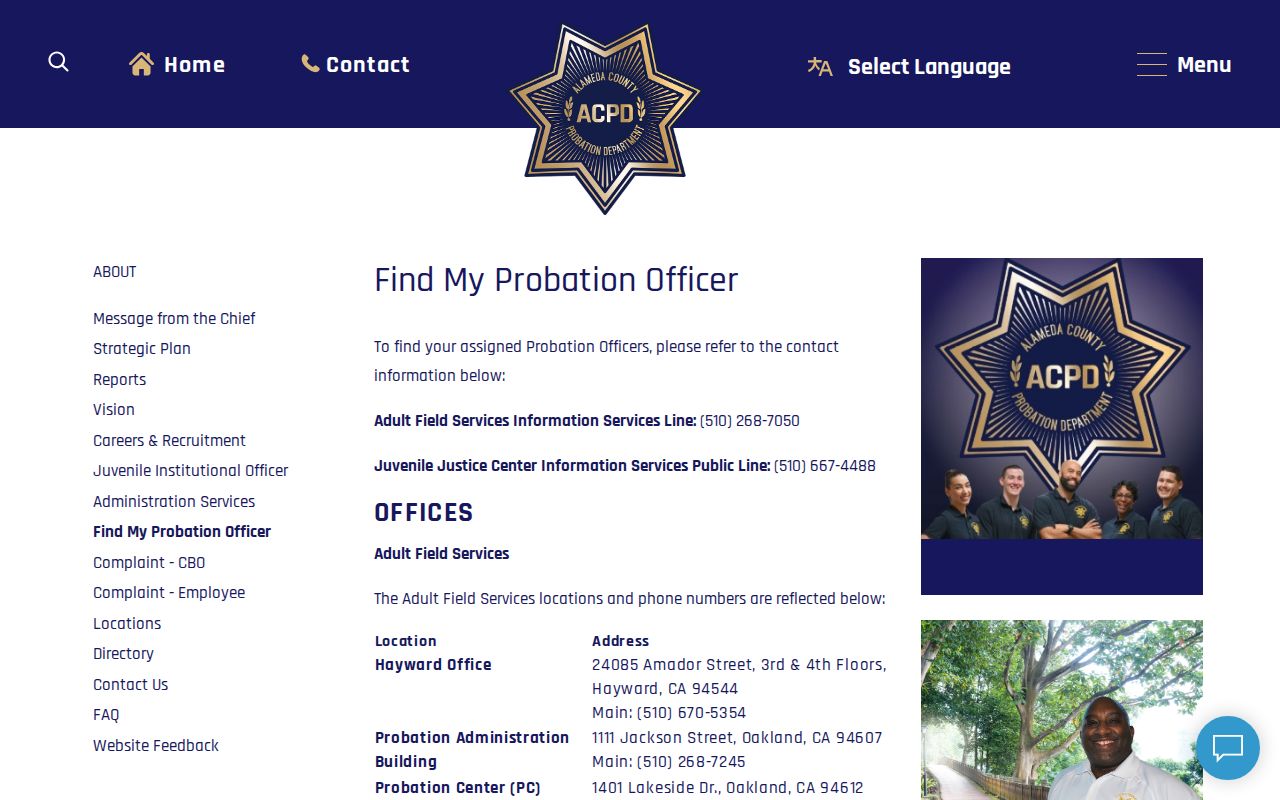
Alameda County Probation supervises adults and juveniles locally. Its Find My Probation Officer page serves people with a supervision relationship, not a public name-search database. Court records are the first place to confirm whether probation was imposed. Releasable department records may also be requested under the California Public Records Act.
The probation office directory shows Oakland, Hayward, and Dublin service locations.
Parole is different. CDCR's Division of Adult Parole Operations provides state supervision after prison, while the Board of Parole Hearings handles suitability decisions in life-term cases. A person can therefore leave the Alameda County jail system and later appear in CDCR custody or parole channels.
Alameda County Criminal Record Offices
The record's stage determines the office. These Alameda County contacts cover the most common handoffs from report to booking, prosecution, defense, and filed case.
Superior Court Criminal Division
René C. Davidson Courthouse
1225 Fallon Street, Oakland
(510) 891-6009
Alameda County Sheriff's Office
1401 Lakeside Drive, 12th Floor, Oakland
(510) 272-6878
District Attorney
1225 Fallon Street, Suite 900, Oakland
(510) 272-6222
Public Defender
1401 Lakeside Drive, Suite 400, Oakland
(510) 272-6600
The Alameda County District Attorney homepage identifies the prosecution office and public services.

That office makes the filing decision between a police report and the Superior Court criminal case record.
Case location can change which clerk answers a copy question. Alameda County Superior Court lists criminal divisions at René C. Davidson and Wiley W. Manuel in Oakland, Fremont Hall of Justice, Hayward Hall of Justice, and East County Hall of Justice in Dublin. When the location is unknown, the courtwide Records Office can be reached at (510) 891-6005 or AskRecordsManagement@alameda.courts.ca.gov. A requester who knows the hearing site should call that criminal division first. Davidson uses (510) 891-6009, Wiley W. Manuel uses (510) 627-4700, Hayward uses (510) 690-2703, Fremont uses (510) 818-7501, and East County uses (925) 227-6700. This regional layout is why an Alameda County record may not be available from the closest courthouse counter.
Alameda County and Federal Record Review
An Alameda County record search does not include every federal event. Federal cases in the region belong to the Northern District of California, while the FBI Identity History Summary is a fingerprint-based self-review channel. State sealing or dismissal questions should be directed to California authorities for the state event.
The FBI's Identity History Summary review page presents its official request route.
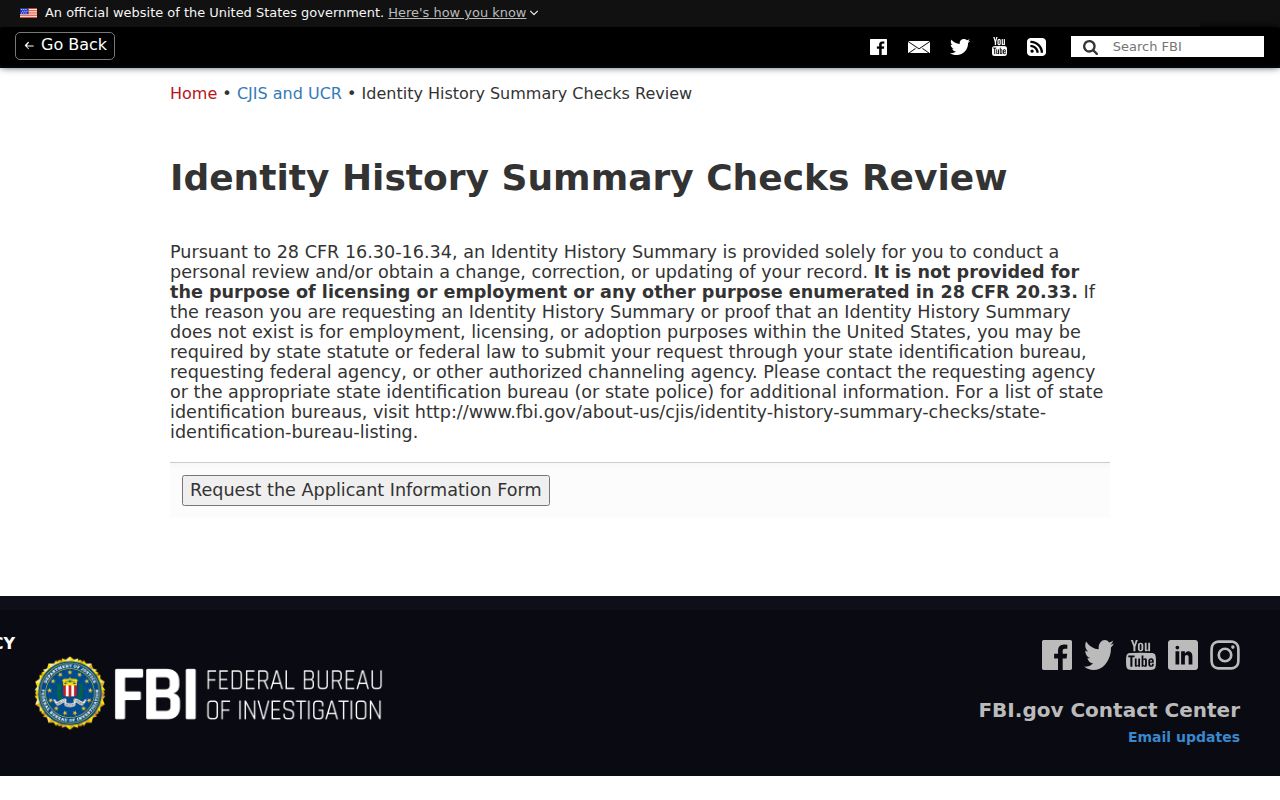
Use that result as a distinct federal record, not as a substitute for Alameda County Superior Court documents or California DOJ's own-record review.
Alameda County Criminal Records by City
Oakland, Fremont, and Hayward are Alameda County's three largest incorporated cities. Each police department controls its own report channels, while filed felony and misdemeanor cases move into Alameda County Superior Court. City records therefore add the agency report and local log to the county jail and court trail.
Oakland Criminal Records
Population 440,646 in the 2020 Census. OPD offers a records counter, NextRequest, and a Daily Log.
Fremont Criminal Records
Population 230,504 in the 2020 Census. Fremont Police handles reports and local warrant self-check routing.
Hayward Criminal Records
Population 162,954 in the 2020 Census. Hayward Police uses report counters and GovQA requests.