
Alameda County Criminal Court Cases
Every felony, misdemeanor, traffic infraction, and related criminal matter filed in Alameda County goes to the Superior Court of California, County of Alameda. There is no separate city criminal court for Oakland, Fremont, or Hayward. The court assigns Alameda County criminal court cases among locations in Oakland, Hayward, Fremont, and Dublin. The assigned site matters because its criminal division keeps the working file and answers copy or calendar questions.
The main Oakland file hub is the René C. Davidson Courthouse at 1225 Fallon Street. Wiley W. Manuel Courthouse also handles criminal and traffic work. Hayward Hall of Justice, Fremont Hall of Justice, and East County Hall of Justice serve other parts of Alameda County. The clerk keeps the complaint or information, register of actions, minute orders, pleas, rulings, disposition, and sentence. Police reports and jail bookings remain with other agencies unless filed as court exhibits.
Five Alameda County Criminal Division Contacts
When the case location is known, contact that Alameda County criminal division. When it is not, the court's record request guidance says to call the criminal locations or the courtwide Records Office at (510) 891-6005. This local routing step can save a failed document request.
Oakland Courts
René C. Davidson: 1225 Fallon Street, (510) 891-6009.
Wiley W. Manuel: 661 Washington Street, (510) 627-4700.
Regional Courts
Hayward: (510) 690-2703.
Fremont: (510) 818-7501.
East County, Dublin: (925) 227-6792.
Alameda County readers who know only a police report number can also test the Sheriff's Docket Finder before calling. It may identify a future public proceeding and its court, but it is not a full file index.
Searching Alameda County Case Records
Use the Alameda Superior Court public portals for status and hearing searches. Public access to the Odyssey criminal portal requires registration. Choose the tool by task, since a near-term calendar and a request for filed documents do not return the same record.
- Open the criminal portal and register for public Odyssey access when prompted.
- Use Smart Search for court records or Search Hearings for a set date range.
- Open the case number and read the register of actions, filing date, court, and hearing entries.
- Use Find Your Court Date only for a hearing within the next five calendar days.
- Submit a Criminal Record Request for copies of non-confidential documents, or call the assigned clerk.
| Field or mode | Type | Required | Notes |
|---|---|---|---|
| Smart Search | Search mode | Not stated | Searches Alameda County court records; public registration is required. |
| Search Hearings | Date-range mode | Not stated | Looks for Alameda County hearings within a chosen range. |
| Name Search | Party-name mode | Portal dependent | May return case numbers and filing dates; results cap at 1,500 cases. |
| Criminal Record Request | Copy workflow | Depends on request | For copies of non-confidential criminal case documents. |
| Find Your Court Date | Calendar mode | Not stated | Shows up to five days of calendar data. |
Alameda County Court Date Tool Limits
The official Find Your Court Date service covers up to five days of calendars and says its data is current as of 5:00 p.m. Pacific. It spans several case types, including criminal and traffic. That narrow window makes it useful for confirming a soon-to-occur appearance, not for reading the life of an Alameda County case.
The source page below shows the court-date interface used for near-term Alameda County calendars.
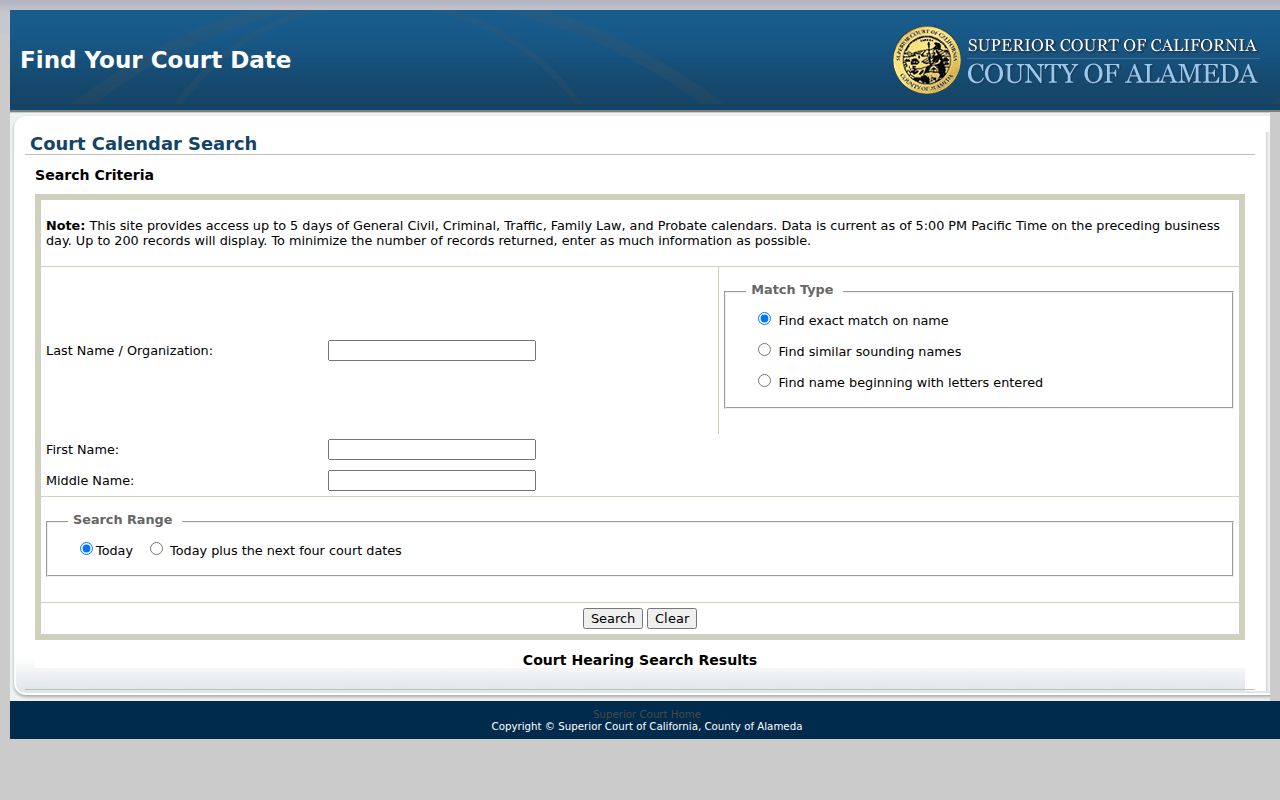
A missing result may mean the date falls outside the window, the matter is restricted, or the case has not reached a public calendar. Use Odyssey or the clerk next.
Inside an Alameda County Case File
An Alameda County court file follows the filed prosecution. It is more useful than an arrest entry when the goal is to learn which counts the District Attorney pursued, what plea was entered, or how the court ruled. A state rap sheet is organized by fingerprint-linked arrest cycles, so it should not be treated as a copy of the case file.
| Case Number and Court | Identifies the Alameda County matter, assigned location, and department. |
|---|---|
| Charging Document | The complaint, information, or indictment states the counts formally filed. |
| Register of Actions | Lists filings, hearings, orders, and other court events in date order. |
| Plea and Motions | Records the response to charges and litigation before plea or trial. |
| Disposition and Judgment | Shows dismissal, acquittal, diversion result, plea, or conviction by count. |
| Sentence and Conditions | May state jail, prison, probation, fines, restitution, and court orders. |
Note: Charges in an Alameda County booking record can change before the prosecutor files the court complaint.
Alameda County Criminal Document Requests
Smart Search is an index and event-viewing channel. A reader who needs the filed complaint, a minute order, or another non-confidential document should use the court's Criminal Record Request portal. The request goes to the court, not the arresting police desk. Confidential, sealed, or otherwise restricted material will not become public merely because a copy request is submitted.
The court's official request page is shown below before the Alameda County document workflow begins.
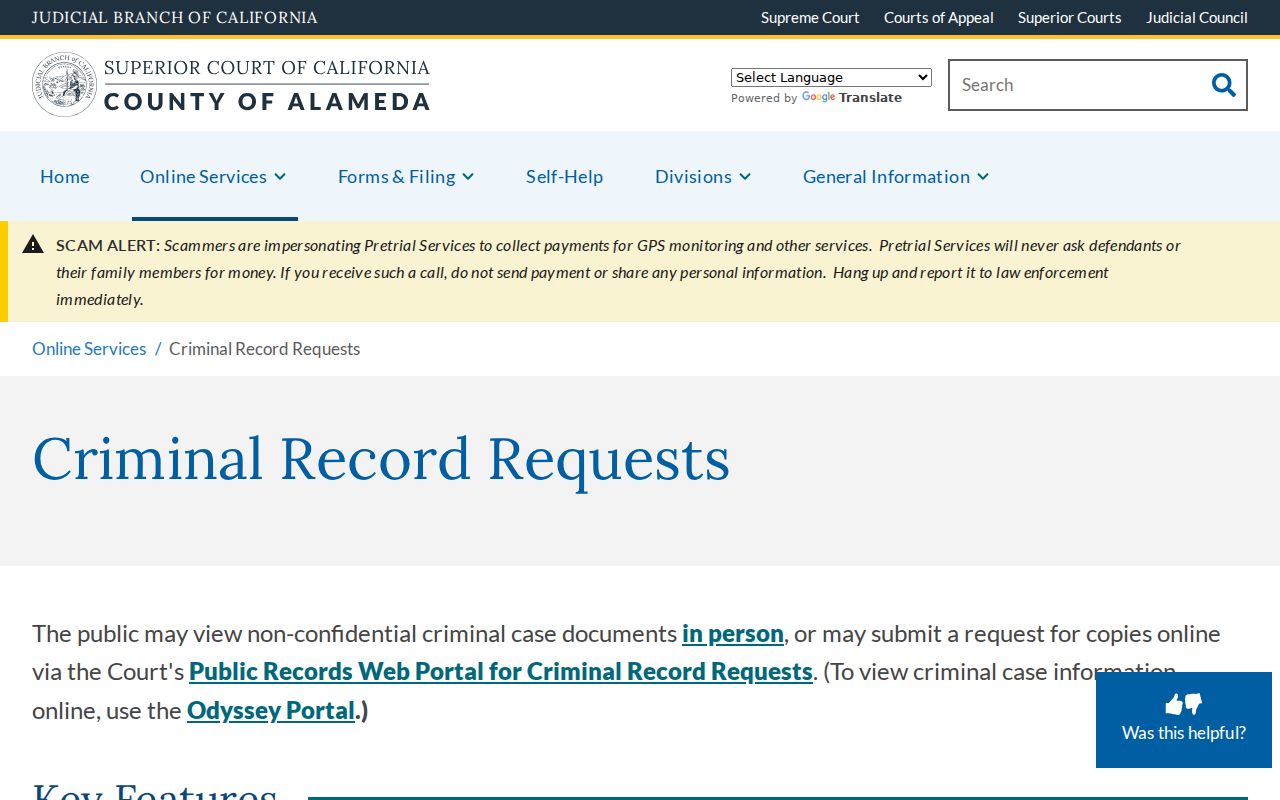
This channel is the right next step when the docket proves a filing exists but the needed document is not available in the remote view.
How a Criminal Case Moves
The court record begins when prosecutors file charges, not when police first make an arrest. Alameda County arraignment entries show the first formal plea and advisements. Pretrial entries can include motions, conferences, and changes to counts. A plea may resolve the case, while a contested matter can proceed to trial. The disposition must be read count by count because one charge may be dismissed while another ends in conviction.
Case flow: Charges Filed › Arraignment › Pretrial › Plea or Trial › Disposition › Sentencing
Once the Alameda County court enters its outcome, that disposition should flow back to California DOJ for the state summary. Anyone reviewing their own DOJ record may need the court disposition if an outcome is missing.
Alameda County Collaborative Court Records
Alameda Collaborative Courts include Drug Court, Family Treatment Court, Reentry Court, and Veterans Treatment Court. The court says Drug Court can accept misdemeanor or felony cases, before or after a plea, and the charge need not be drug-related. These programs use treatment as part of the case path, but the Alameda County criminal file still records the hearings, plea posture, orders, and final disposition.
Program participation should not be mistaken for an automatic dismissal. Read the Alameda County register of actions and final order. Drug Court lists OCCS@alameda.courts.ca.gov and (510) 263-4342 for its program contact.
Federal Cases Are Outside Alameda County Court
Federal charges arising in Alameda County do not appear as Superior Court cases. They belong to the U.S. District Court for the Northern District of California. The Northern District court overview identifies an Oakland courthouse as part of that separate system.
The federal court source below helps distinguish that court from Alameda County's trial courts.
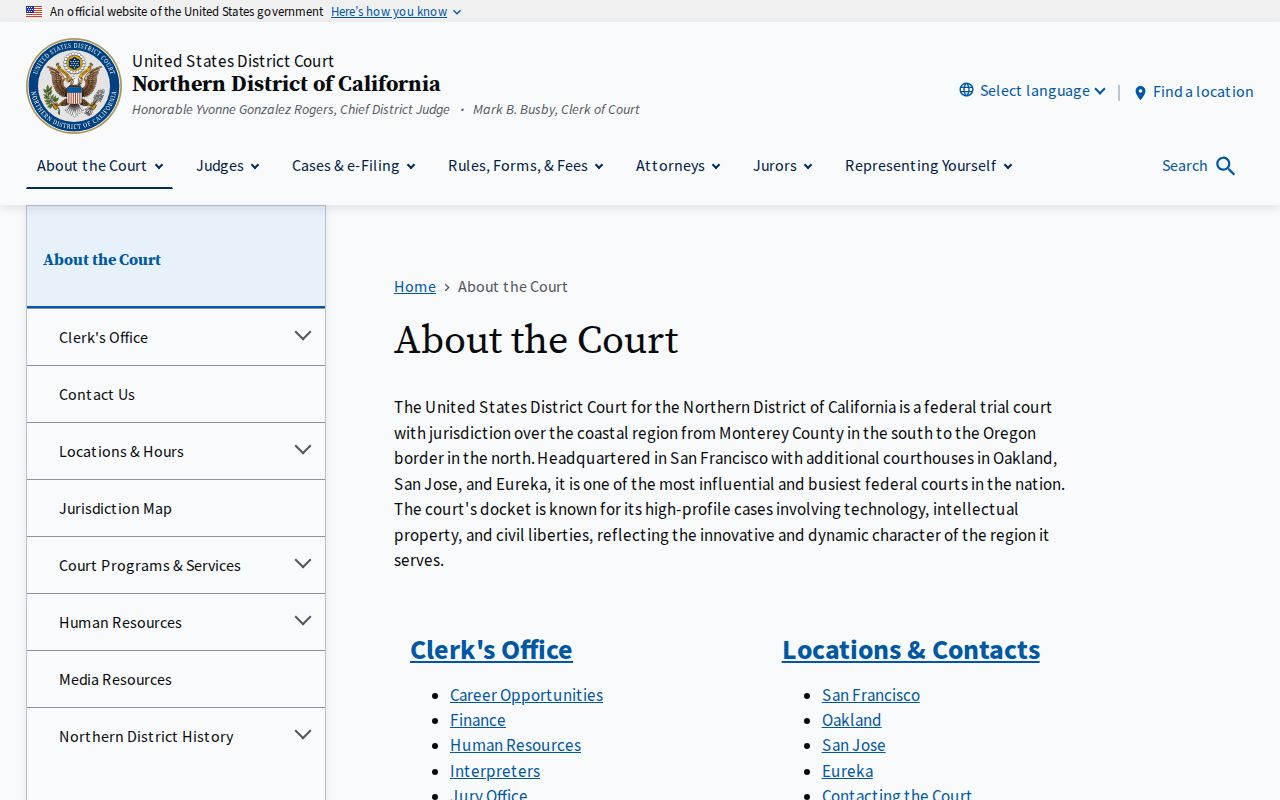
Use PACER for the federal docket. Alameda County Odyssey, the Sheriff's jail locator, and California DOJ each serve a different records layer.
Alameda County Criminal Docket Finder
The Sheriff's Criminal Docket Finder searches by docket number plus court name, or by police report number plus agency name. It requires CAPTCHA, preserves hyphens and spaces in report numbers, excludes juvenile data, and shows people with future public hearing dates. Its agency menu reflects the many police agencies that can feed Alameda County proceedings.
The official docket form shown below is a bridge from a report or docket number to a future court event.
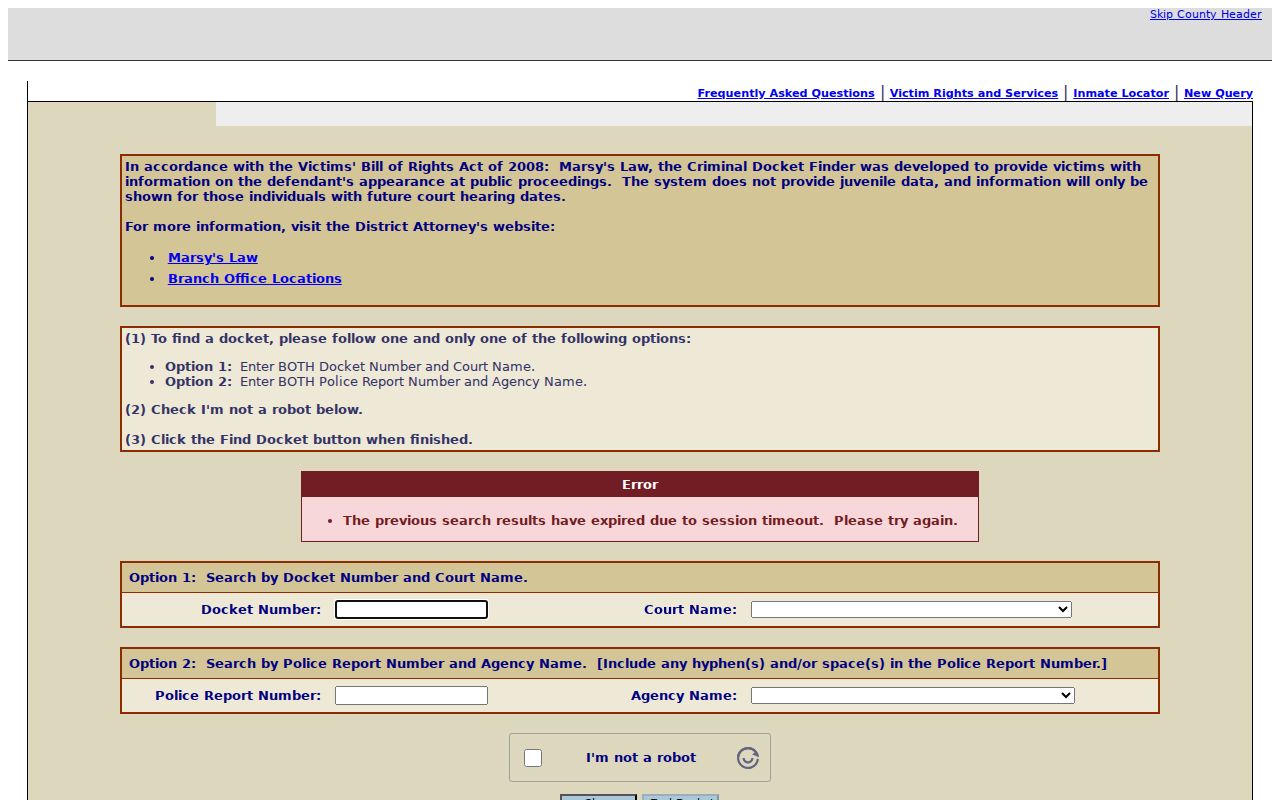
Do not read a blank result as proof that no Alameda County criminal case exists. Use the court portal and clerk channels for full case research.
Case Record Access & Restrictions
California Rule of Court 2.507 controls what remote electronic calendars, indexes, and registers of actions may show. Date of birth and other sensitive identifiers should not be expected in the public remote display. Juvenile matters, sealed Alameda County cases, protected victim information, and confidential documents may be absent or redacted. A paper file can also contain material that is not open to the public.
Rule 2.507 limits remote display. The California Public Records Act does not turn confidential court or rap-sheet data into open records.
When an Alameda County case does not appear, ask the assigned criminal clerk whether it is old, sealed, confidential, juvenile, not yet filed, or held at another location. The courtwide Records Office can help route an unknown file.
The official portal landing page below is the safest place to confirm which Alameda County court system covers the record type.
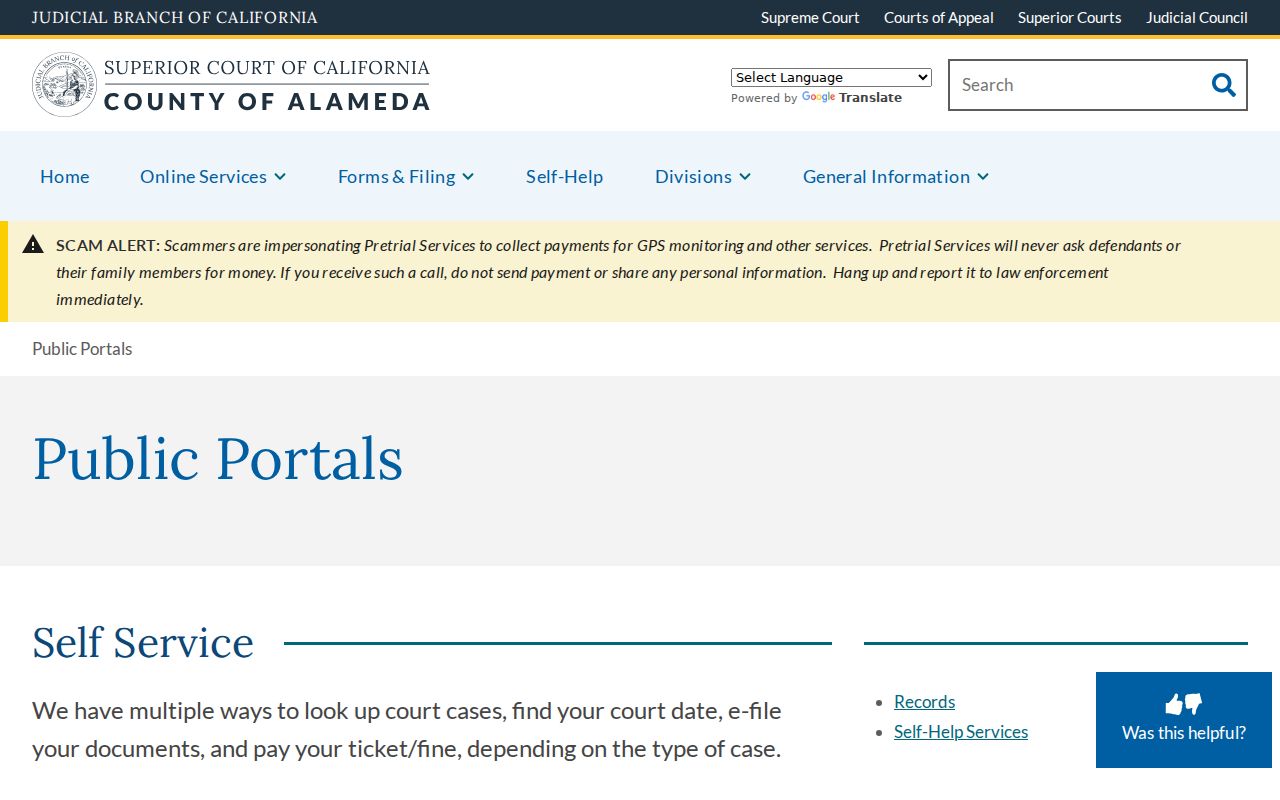
That distinction prevents eCourt, which serves listed noncriminal case types, from being used as the Alameda County criminal portal.